
Generative AI only creates value when it is built with purpose, structure, and responsibility. At SAP, this mindset is captured in the principle Relevant, Reliable, and Responsible. But principles alone are not enough. What really matters is how an initial idea turns into a secure, scalable, and enterprise-ready feature.
At Keyuser.ai, we think exactly the same way. AI is not a shortcut. It is a lifecycle.
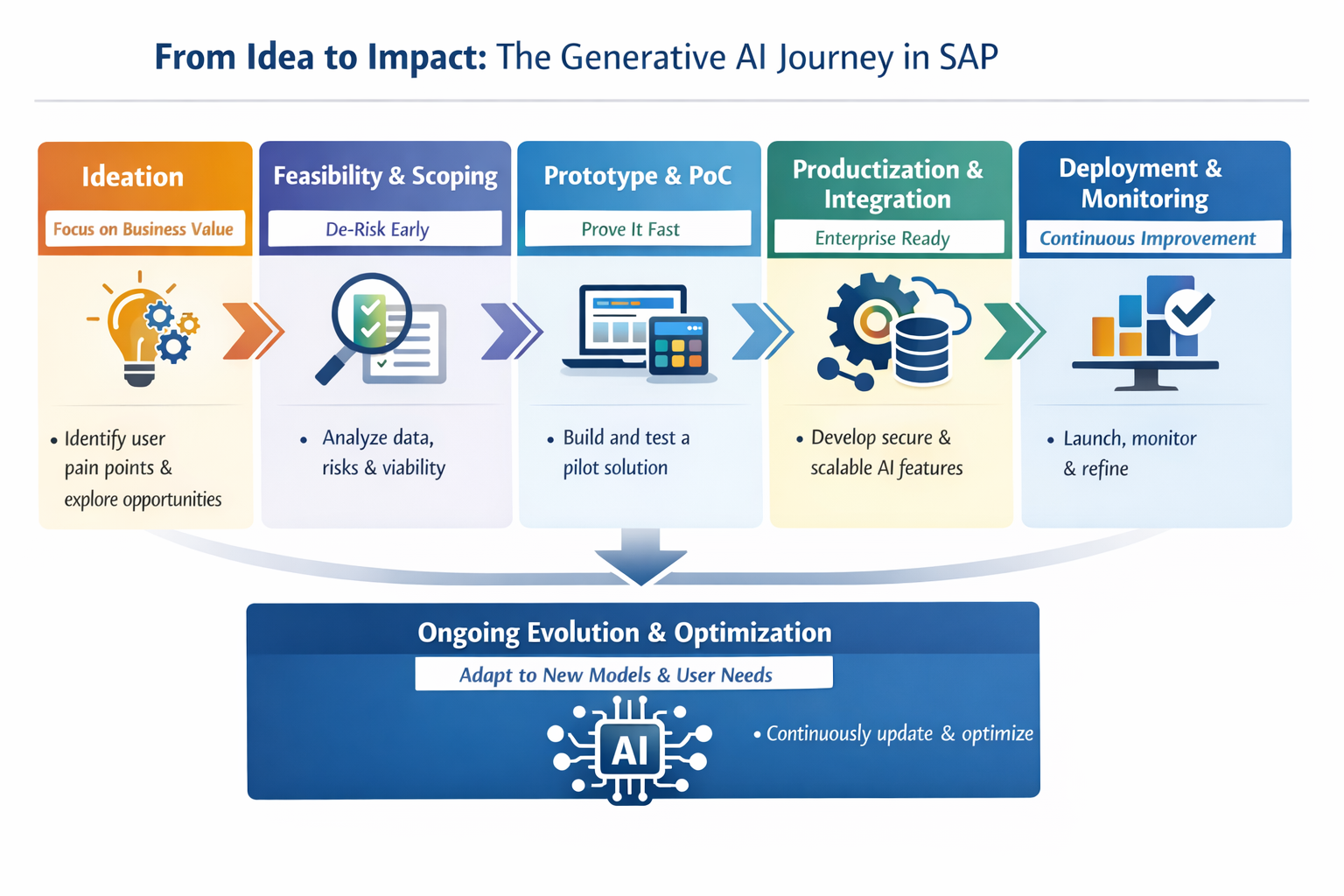
A Structured Journey, Not a One-Off Experiment
Building generative AI for SAP environments is never a solo effort. How is business value defined in this process? Product Management defines business value, UX shapes user interaction, Solution Management ensures market fit, and developers and data scientists bring it all to life. How does this collaboration help before production code is written? This collaboration ensures that by the time production code is written, risks are already reduced and expectations are clear.
Stage 1: Ideation, Start With Business Value
We believe the right starting point is always a real pain point. Where do users lose time? Where does manual effort slow down decisions? Generative AI is explored as a supporting capability, not as a gimmick. Our role is to challenge ideas early and ask whether this is truly an LLM problem or something better handled by classic automation.
Stage 2: Feasibility and Scoping, De-Risk Early
Not every task belongs to AI. What are clear warning signs that AI may not be suitable for me? Deterministic logic, strict calculations, or zero-tolerance accuracy scenarios are clear warning signs. What factors do I assess upfront before using AI? We assess data access, hallucination risk, security, and cost efficiency upfront. Why is this assessment step essential for me? We see this step as essential to avoiding AI experiments that look promising but fail to scale in real enterprise environments.
Stage 3: Prototype and PoC, Prove It Fast
Before productization, assumptions must be tested. How do I validate whether the idea actually works in practice? With small datasets, carefully designed prompts, and multiple models, teams validate whether the idea actually works in practice. When is a PoC successful from our perspective? From our perspective, a PoC is successful only if it delivers usable output, not just impressive demos.
Stage 4: Productization and Integration, Where AI Becomes Enterprise
This is where experimentation ends and engineering begins. Secure integration, SAP-native data access, governance, and scalability become critical. We see that AI delivers the most value when it fits seamlessly into existing SAP processes instead of forcing users into new tools or workflows.
Stage 5: Deployment, Monitoring, and Continuous Evolution
Unlike traditional software, AI never stands still. What must I continuously monitor in AI systems? Quality, cost, user feedback, and model behavior must be continuously monitored. Why do new models, changing data, and evolving user expectations require ongoing adjustment? New models, changing data, and evolving user expectations require ongoing adjustment. How do we see generative AI over time? We see generative AI as a living system that must be actively maintained to remain reliable, trustworthy, and valuable over time.
Our Perspective
We do not see generative AI as a generic add-on for ERP systems. We see it as a capability that must be carefully designed around business context, SAP processes, and real operational needs. That is how generative AI moves from idea to impact and how it delivers sustainable, long-term value.