
SAP often positions AI in SAP landscapes as something that requires BTP and Joule. We looked at this claim from a practical, on-premise perspective and asked a simple question: what do SAP customers actually need to use AI productively in their systems?
Our conclusion was clear. AI in SAP does not have to be cloud-bound, platform-dependent, or tied to a single vendor roadmap.
Our Perspective on AI in SAP
At Keyuser.ai, we designed AI assistance to work directly with SAP systems such as ECC 6.0 and S/4HANA. The focus is not on replacing SAP tools, but on augmenting daily work with system-aware intelligence.
The guiding idea is simple: AI should understand your real SAP system, operate where your data lives, and respect existing on-premise boundaries.
How It Works in Practice
We built three complementary modes that support different SAP use cases.
Ask SAP: Conversational Query Agent
This mode allows users to interact with their SAP system using natural language. What kind of SAP questions can I ask directly? Questions like open purchase orders by location, invoices posted over a specific period, recent master data changes, or failed background jobs can be asked directly. Where do the answers actually come from? The key point is that the answers are generated from your actual SAP tables, code, structures, and relationships, not from generic SAP documentation or assumptions.
Agent Mode: n8n Workflow Integration
In this mode, AI is combined with automated workflows. How many SAP tools can I trigger using natural language? More than 40 specialized SAP tools can be triggered through natural language. How are the correct technical actions selected and executed? The system selects the correct technical actions automatically and executes them in a controlled way. When is this approach especially useful for me? This approach is especially useful for operational tasks, recurring checks, and guided problem resolution.
Operational Support and Helpdesk Use Cases
AI assistance is also available as contextual help directly within on-premise SAP systems. This includes real-time transaction guidance, popup chat support, and helpdesk-style assistance without moving data outside the system landscape.
How This Differs From Joule
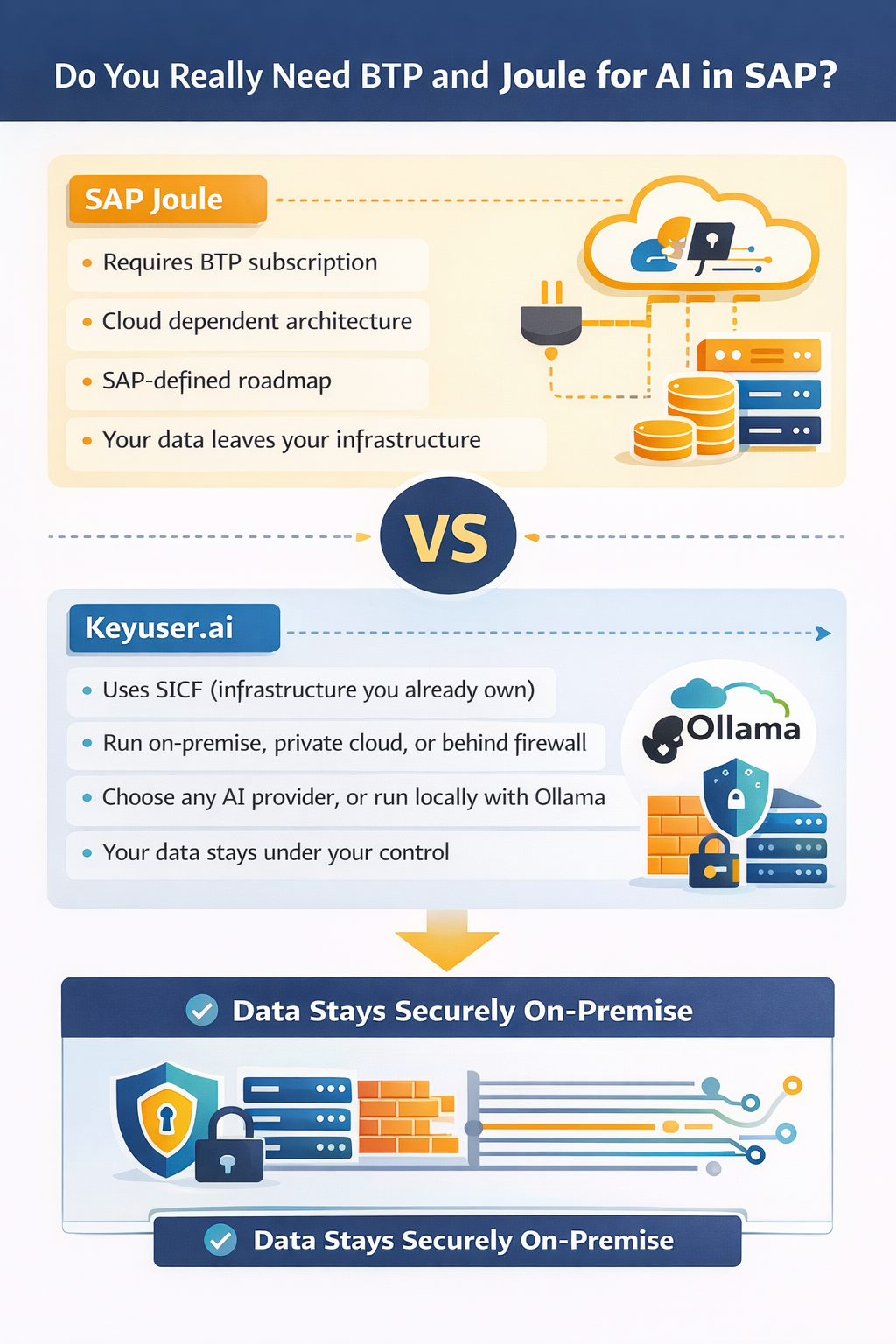
When we analyze the SAP Joule approach, several structural assumptions stand out. What does the SAP Joule approach rely on? It relies on BTP, follows a cloud-dependent architecture, and ties AI capabilities closely to SAP's roadmap and pricing model. What happens to data in this setup? In this setup, data typically leaves the customer infrastructure.
Our approach is different by design. Why do I rely on SICF and standard SAP infrastructure that customers already operate? We rely on SICF and standard SAP infrastructure that customers already operate. Where is deployment possible? Deployment is possible on-premise, in private cloud environments, or behind a firewall. Can AI providers be chosen freely? AI providers can be chosen freely, including local models such as Ollama. Why does data remain fully under customer control? Most importantly, data remains fully under customer control.
Closing Thoughts
We see AI in SAP not as a licensing or platform question, but as an architectural one. With the right design, AI can be system-aware, secure, and flexible without mandatory cloud dependencies. For many SAP customers, that distinction makes all the difference.